December 19th, 2012
05:17 PM ET
Marijuana use holds steady among U.S. teens
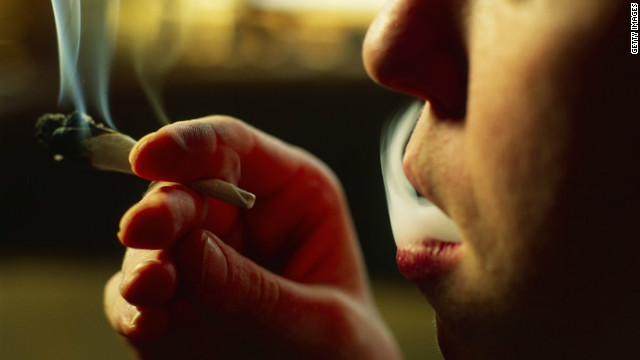
Marijuana use is holding steady among eighth, 10th- and 12th-graders in the United States and tobacco smoking rates remain low.
Those are some of the results published in the annual Monitoring the Future study, a survey of more than 45,000 8th, 10th, and 12th graders from 395 public and private schools. It was released Wednesday.
Each year, the survey gathers information from teens about their use of alcohol, drugs, and tobacco, as well as asking them questions regarding their attitudes about the drugs.
This year, 6.5% of 12th-graders said they smoke marijuana daily. That’s slightly down from 2011, when 6.6% said they smoked it daily.
Teens’ perception about the harmfulness of using marijuana was down, which may signal future increases in marijuana use, according to the study’s principal investigator, Lloyd Johnston.
Overall, 41.7% of eighth-graders perceive occasional marijuana use as harmful and 66.9% see regular use as harmful. As teens get older, their perception of harm decreases, the survey showed, with only 20.6% of 12th-graders seeing regular use as harmful.
“Marijuana use that begins in adolescence increases the risk they will become addicted to the drug," says Dr. Nora Volkow, director of the National Institute on Drug Abuse, in a statement. "The risk of addiction goes from about 1 in 11 overall to about 1 in 6 for those who start using in their teens, and even higher among daily smokers.”
New this year were questions about “bath salts," products that contain designer drugs with stimulant effects. Very few students reported having used bath salts in the previous twelve months: 0.8%, 0.6%, and 1.3% for grades eight, 10, and 12, respectively.
The use of synthetic marijuana products remained stable, with 11.3% of 12th-graders reporting having used them. Other than alcohol and tobacco, this is the second most widely used drug among 10th- and 12th-graders after marijuana. The products are generally sold on the Internet or over the counter, with names such as K-2 and spice. They are produced by spraying herbs or plant materials with the chemical elements found in marijuana.
Use of other illicit drugs showed no significant change between 2011 and 2012. Those drugs include cocaine, crack, heroin, hallucinogens, amphetamines, sedatives, tranquilizers or narcotics taken without medical supervision. Only salvia, ecstacy and using heroin without a needle showed significant declines.
Adderall is one drug that showed some sign of increasing, but only among 12th graders, and not very significantly. Its use increased 1.1% from 2011 to 2012.
Alcohol use, which declined in 2011, showed an increase among 12th-graders. Twenty-four percent of high school seniors reported binge drinking two weeks prior to the survey, an increase of 2%.
“The nation’s teenage drug problems are far from disappearing,” concluded Johnston. He noted that new drugs are appearing on the horizon, products that include synthetic marijuana and “bath salts."
According to Johnson "synthetic drugs like these are particularly dangerous, because they have unknown, untested, and ever-changing ingredients that can be unusually powerful, leading to severe consequences. Users really don’t know what they are getting, and as the thousands of calls to the nations’s poison control centers relating to these drugs indicate, they may be in for a very unpleasant surprise.”
The Monitoring the Future survey was sponsored by NIDA and the University of Michigan, which designed and conducted the study.
Use of marijuana has decreased slightly since 2011 according to survey results, however the risk of adolescent addiction is still there; as they increase in age the perception of harmfulness of this substance decreases. Studies show that drugs laced with other chemicals have also become popular in the united states, including the "bath salts" consumed by the "man eating zombie" earlier in 2012. What is the United States doing to decrease the number of teens who become involved in drugs?
|
Friday, December 21, 2012
Marijuana Use

Wednesday, September 26, 2012
More Behind The Big Win
45 days of intel work led to drug lord's capture in Venezuela
updated 6:24 PM EDT, Wed September 19, 2012

STORY HIGHLIGHTS
- Venezuelan authorities give new details on capture of Daniel "El Loco" Barrera
- It took 45 days and 14 intelligence teams to find him
- Venezuela's justice and interior minister makes no mention of U.S. help
(CNN) -- It took 14 teams and 45 days of daily intelligence operations to nab one of Colombia's last great crime bosses in Venezuela, an official in that country said.
Venezuelan Justice and Interior Minister Tareck El Aissami on Wednesday gave the first detailed account of the capture of accused drug lord Daniel "El Loco" Barrera in San Cristobal, Venezuela.
The operation to capture Barrera began when Colombian authorities shared intelligence with Venezuela about his whereabouts on August 6, El Aissami said.
Venezuela then deployed 14 "intelligence and search" teams in three states and the Venezuelan capital to try to locate him.
Officials tapped 69 pay phones that may have been used by Barrera to manage his alleged drug empire in Colombia and beyond, the minister said.
The monitoring operation stretched for weeks, as Barrera rarely made phone calls himself, preferring to have third parties use the public phones to call Colombia to run the business, El Aissami said.
Colombian President Juan Manuel Santos announced the arrest in a televised speech Tuesday.
He called Barrera the "last of the great (crime) bosses" and said the operation was directed from Washington, with collaboration between British, Colombian, U.S. and Venezuelan authorities. The British intelligence agency MI-6 and the CIA played a role, he said.
The Venezuelan minister, however, did not mention either the United States or Britain and described it as a solely Venezuelan-Colombian operation.
The United States and Venezuela have butted heads over anti-drug operations. Venezuela kicked the U.S. Drug Enforcement Administration out from the country in 2005, and the United States has published reports questioning Venezuela's anti-drug efforts.
This week's arrest is evidence that Venezuela is tough on drug trafficking, El Aissami said.
Barrera was in possession of a fake passport under the name of "Jose Tomas Lucumi Popo," the minister said.
The alleged drug lord had also undergone multiple plastic surgeries to change his appearance, in both Colombia and Venezuela, he said.
In October 2010, Colombian authorities said they found more than $29 million and 17 million euros in cash stashed in two homes that Barrera owned. At the time, the South American country's defense minister called it the "biggest drug-money seizure operation in the country's history."
Earlier that year, the U.S. Department of the Treasury said Barrera played a significant role in international drug trafficking and described him as one of Colombia's most-wanted drug traffickers, noting in a statement that the Colombian government had offered a $2.5 million reward for information leading to his capture.
The statement said Barrera operated primarily in the eastern plains of Colombia, between the capital of Bogota and the Venezuelan border.
An indictment unsealed in a Florida federal court in September 2011 accuses Barrera of conspiring to manufacture, distribute and import cocaine into the United States. If convicted on those charges, he faces a maximum sentence of life in prison, the U.S. Attorney's Office said at the time.
Drug Lord Captured
Colombian president: Wanted drug lord captured
updated 10:44 PM EDT, Tue September 18, 2012
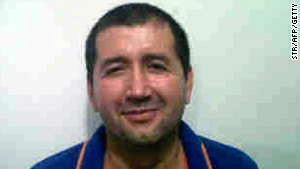
Daniel "El Loco" Barrera
STORY HIGHLIGHTS
- NEW: Venezuela's interior minister will discuss capture, drug seizure Wednesday
- Colombian President Juan Manuel Santos announced the capture
- Daniel "El Loco" Barrera is accused of alliances with paramilitaries, drug trafficking
- The CIA assisted in his capture, Colombian president says
(CNN) -- Authorities have captured one of Colombia's last great crime bosses, President Juan Manuel Santos said Tuesday night.
Accused drug lord Daniel "El Loco" Barrera was captured in San Cristobal, Venezuela, Santos said. Barrera is accused of alliances with paramilitaries and the Revolutionary Armed Forces of Colombia guerrilla group in addition to drug trafficking crimes over a period of more than 20 years.
"He is the last of the great (crime) bosses. This is very forceful blow," Santos said in televised remarks.
"This is a very important step toward the security that we want to achieve in this country," he said.
The operation, directed from Washington, came about with collaboration between British, Colombian, U.S. and Venezuelan officials, Santos said.
"I want to thank the Venezuelan government, President (Hugo) Chavez and his team, for this great collaboration that has produced this capture," Santos said.
The MI6 British intelligence agency and the CIA also assisted, he said.
Venezuela's interior minister will discuss Barrera's capture and "the seizure of more than a ton of drugs" in a news conference Wednesday morning, the nation's information ministry said in a statement.
In October 2010, Colombian authorities said they found more than $29 million and 17 million euros in cash stashed in two homes that Barrera owned. At the time the South American country's defense minister called it the "biggest drug-money seizure operation in the country's history."
Earlier that year, the U.S. Department of the Treasury said Barrera played a significant role in international drug trafficking and described him as one of Colombia's most wanted drug traffickers, noting in a statement that the Colombian government had offered a $2.5-million reward for information leading to his capture.
The statement said Barrera operated primarily in the eastern plains of Colombia, between the capital of Bogota and the Venezuelan border.
An indictment unsealed in a Florida federal court in September 2011 accuses Barrera of conspiring to manufacture, distribute and import cocaine into the United States. If convicted on those charges, he faces a maximum sentence of life in prison, the U.S. Attorney's Office said at the time
Subscribe to:
Posts (Atom)